
Have you ever felt the burning desire to craft your own narrative? As a busy surgeon, I often pondered it, but spare time was a luxury I rarely had. My mind was buzzing with brilliant ideas, but the thought of translating them on to the paper felt overwhelming. Only after retiring from surgery two years ago did I realize the abundance of time available to fill the void left by the 60-90 hour work weeks. It was during a sleepless night that a striking vision came to me, as if it were projected onto the ceiling above my bed. I can accomplish this! I can compose an engaging tale. It started while running a 10 kilometer on a sunny morning run. A faint story quickly passed through my thoughts, and as I continued running, fragments of related stories gradually came together. At this point, the ideas started flowing.
Real-life experiences make for the most compelling stories. To add excitement, it is necessary to fictionalize events while keeping them grounded in reality. It was on one of my morning runs when my mind drifted back to a few years earlier. I met a skilled surgeon from Barcelona who traveled all the way to Toronto to deliver a captivating talk at our yearly U of T Update in General Surgery. After a quick stop at the airport to pick him up, I drove him directly to the hotel where the meeting was being held the following morning. Despite being around the same age as me, he stood taller with a distinguished grey beard and flowing long grey hair. With a pleasant Spanish accent, he spoke softly, captivating me with his delightful manner. It was evident that he had an abundance of stories to share. I was happy to listen.
After he had checked in, we ended up in the hotel bar, where the soft jazz music played in the background, creating a relaxed atmosphere. He not only had a talent for storytelling, but he also had a refined taste for expensive whiskey. Despite my assigned duty of picking up this renowned surgeon from the airport, the captivating stories I heard made the $150 bill worthwhile.
One story he told was about an unfortunate resident who misdiagnosed a man with acute appendicitis. He sent him home with a diagnosis of gastroenteritis. That could have been me! I thought as he spun the tale. I’ve done that exact thing before. When he came to the part about the resident getting jailed for manslaughter after the patient died, a wave of shock washed over me. Holy shit! That’s a story that hits close to home for me. It’s something that I can easily imagine happening in my own life.
With this real-time event as my starting point, I had the cannon fodder I needed to weave my story of “The Sailor” into a captivating narrative. Throughout my tenure as Chief of Surgery for 7 years and later as Chief of Staff for two years, I encountered many unexpected events that showed how medical politics mirrors the complexities of other political arenas. Dive into the story and immerse yourself in the thoughts and emotions of this poor surgeon as he navigates through life-altering experiences.
I had just returned from a run, my skin glistening with sweat under the warm rays of the May sun. I felt euphoric, like I was on cloud nine, after successfully sailing my boat from the Dominican Republic to Toronto over the course of three weeks. My mind was filled with a whirlwind of sailing stories. On the front doorstep of my house in King City, Ontario, two men sat, engaged in an intense conversation. They had dressed casually, wearing comfortable jeans and t-shirts. One man confidently strutted around in his unconventional choice of footwear – Birkenstock sandals paired with socks. That should have been my clue that something was off with these guys… The air crackled with an inexplicable energy, making me feel both intrigued and unsettled. His outfit consisted of blue jeans paired with an untucked shirt. He sported a slight potbelly, and his face was adorned with a 7-day-old beard. A gentle breeze swept through, causing a strand of his golden hair to fall delicately across his left eye. The other man stood a few inches shorter, his silence adding an air of mystery. He too, dressed himself casually, as if he were going to grab some Chinese takeout from the local fast-food chain in town.
“We are from CSIS, Canada Security Intelligence Services,” said the potbellied one. “Could we ask you some questions?”
They handed me their ID on a laminated plastic sheet, and I furrowed my brow in confusion. It took me a second glance to really take in what I was looking at. There was the CSIS logo and a Canada maple leaf icon on the top. I couldn’t distinguish whether it was genuine or artificial, but the guys seemed innocuous.
“Let me explain,” he continued. “You have no obligation to speak to us. We parked our car ½ a mile away and walked here so your neighbours wouldn’t see our car.” I glanced around. I live on 2 ½ acres and I don’t even know my neighbours. The sole encounter I had was when our Rottweiler got loose and frightened their gardener, who fled in his car and never came back. The neighbour, with a crusty demeanor, made it clear that any future occurrence would result in legal consequences.
“If you like, we can go to a coffee shop?” he asked.
I thought about their suggestion before I answered. “No, it’s OK. We can talk in my office.”
They followed me around to the back of the house, where we traipsed past my wife, Ileana. She was drinking coffee under the shade of our red umbrella, talking with her assistant, Angie. A confused look emanated from her suspicious eyes. “I’ll explain later,” was all I said. Ileana shook her head as if to say, “What the hell are you up to now?” She turned to Angie who shrugged her shoulders.
“Do you know this woman?” asked the potbellied one once we had sat down in my office.
“Yes. That’s Jackie. She has helped with some trips to China. She organized a Zoom Meeting during COVID where I gave a talk,” I answered.
“We flagged her because her business of trading maple syrup has morphed into a business of medical conferencing. For us, that is a red flag. Our division is involved with protecting medical proprietary research. Often, the Chinese infiltrate in this manner, befriending naïve Canadian doctors and then they steal their research.”
I burst out laughing. “I do no research. Everything I talk about in laparoscopic surgery is on the internet.”
“What are you signing here?” The potbellied man showed me a picture of a signing ceremony at one hospital I visited in Xian. I looked at it and shook my head.

“I have no idea. It was all in Chinese,” I replied.
After 30 minutes of intense discussion, they concluded I did not pose any danger to national security, and they promptly departed. I sat down with Ileana and described the conversation. She was livid. “In Guatemala, where I grew up, if a government spy approached you, it meant you were going to jail, or you would disappear permanently.”
She picked up the phone and called Sam, our friend and advisor on all matters legal. He rushed over and I recounted the story. When I got to the part about getting jailed or forced disappearance, he burst out laughing. “Those guys have no power. They can only collect information. They are harmless!” Sam pondered something before he continued. “It does, however, lend itself to a great story.”
That was all the prompting I needed to write “The Embryo”.

Complication management is an integral aspect of being a surgeon. Every time I faced a complication, a wave of devastation would wash over me. The families of the patient would often respond with anger, their voices filled with frustration and resentment. How could I have let their beloved family member go through such a devastating ordeal? The sinking feeling of having failed, even when I had done my best, did not get any better with time and experience. Inevitably, a few sleepless nights filled with feelings of inadequacy would follow. As miserable as I felt, it surprised me how much worse it was in other places in the world.
As a way of sharing knowledge, the hospital I worked at frequently hosted visiting surgeons from China for extended periods of 3-6 months. Sitting in the surgeons’ lounge one night, I struck up a conversation with a visiting surgeon from China. Suddenly, my cellphone pierced the air with its ringing.
“Dr. Hagen, can you come and see a patient who had a colon resection yesterday? She has a tachycardia and looks sick,” said the nurse with a worried tone to her voice.
The visiting surgeon tagged along when we went to see the patient. She was a 50-year-old woman who had an uneventful laparoscopic colon resection performed for cancer of the colon. She looked unwell. Her abdomen was exquisitely tender, a condition called peritonitis. Intestinal fluid was leaking into her abdominal cavity. I arranged emergency surgery.
A hole in the small intestine caused the peritonitis. Suturing the hole closed and washing out the abdomen corrected the problem. I sent her back to the surgical floor in good condition after the successful surgery. The visiting surgeon and I went to talk with the family afterwards.
“A hole in the small intestine caused the peritonitis. I fixed it and washed out the abdomen. I think she will be fine.” I explained.
“What caused the hole?” asked the daughter.
“Not sure,” I answered. “A possible cause includes an injury from the instruments because they are sometimes out of view while holding the intestine during laparoscopic surgery.”
Grateful beyond words, the family profusely thanked me for ensuring her well-being and expressed their relief that she would be alright. I walked back to the surgeons’ lounge with the visiting surgeon, and as we sat down. His anxiety manifest itself with inability to sit still. His right leg bounced up and down in a nervous tic. It seemed he did not know where to place his hands. His eyes dated around the room as if looking for hidden dangers. He turned to me, his eyebrows furrowed in confusion.
“That was incredible,” he said. “In China, the family would have hit you! No surgeon in China would have operated on another surgeon’s complication for fear of getting hit. Families have murdered surgeons in China following complications. It makes it difficult to attract surgeons into the field.”
I stared at him incredulously. Despite the challenging consequences of facing angry families in Ontario with litigation and College complaints, they were nothing compared to what this poor visiting surgeon from China endured. It was at that moment when I realized this experience would become an incredible story.

Ileana once posed a question that would change my life: “Would you like to join me on a medical mission to Guatemala?” The Organization is HELPS International. We joined forces with a dedicated medical team from Bakersfield, who diligently gathered supplies for the mission over the course of a year. When setting up a field hospital in the remote mountains of Guatemala, it is crucial to have a comprehensive inventory of supplies such as sutures, dressings, surgical drapes and gowns, antibiotics, mesh for hernia repairs, and various other necessary items. That was 20 years ago.
Since that time, we have been actively taking part in a medical mission to Guatemala each year, except for the years when the pandemic prevented us from doing so. We transform an abandoned schoolhouse into a makeshift hospital, complete with medical equipment and beds. In preparation for the week of surgery, a multitude of items are transported, ranging from generators and hospital beds to linen, laparoscopic equipment, chairs, stoves, and food. Over 100 dedicated staff members volunteer their time and skills to offer surgery and medical care to the most impoverished areas of Guatemala. The line of patients stretches on for days as they eagerly await their chance to see us. There is no other source of medical care for them except us.
During her medical school training in Guatemala, Ileana was required to spend 6 months in the remote mountains, where she provided care and often found herself alone in the countryside torn apart by civil war. I have embedded a few of her remarkable stories into “The Mission”. You will decide for yourself which of the events are true events and which have been fictionalized. It is a great story!

I’m heading south for the winter on our sailboat Ileana. More exciting stories to work on while basking in the warm Caribbean sun. I will travel across Lake Ontario to Oswego, through the Erie Canal, to the Hudson River. Entering the open ocean from New York City between the hurricanes, I will make my way to Hampton Virgina. The departure date to sail south with the Salty Dawg Sailing Association is on November 1st….weather permitting.
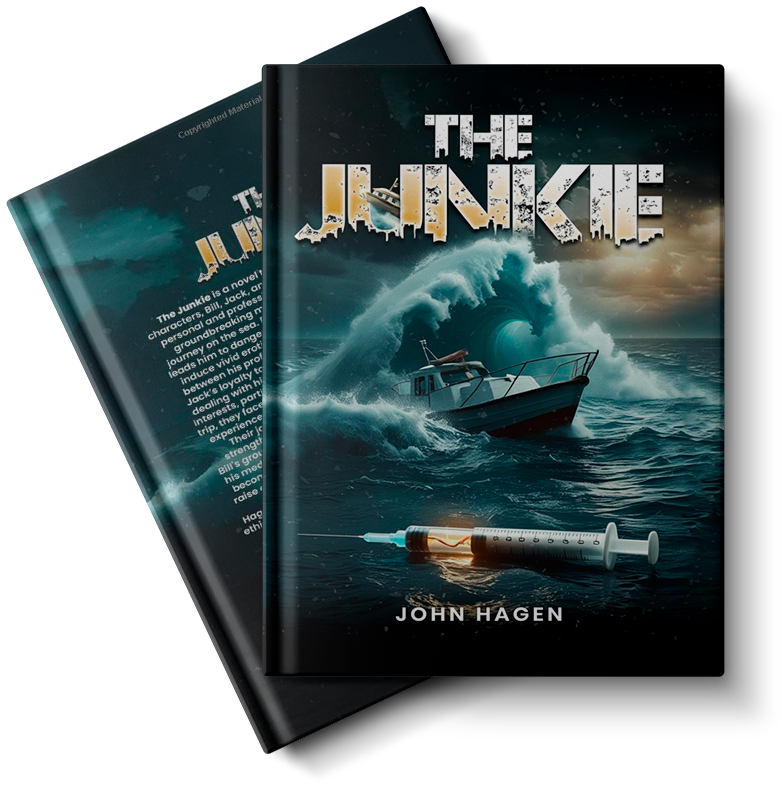
The Junkie is a novel that intertwines the lives of several characters, Bill, Jack, and Katherine, as they navigate through personal and professional challenges, including addiction, groundbreaking medical discoveries, and a dangerous journey on the sea. Bill is a skilled surgeon, but his addiction leads him to dangerous behavior, including using propofol to induce vivid erotic dreams. The novel explores the tension between his professional successes and personal demons. Jack’s loyalty to Bill gets tested as he tries to help him while dealing with his own professional challenges and romantic interests, particularly with Katherine. Embarking on a sailing trip, they face numerous challenges, including a near-death experience during a storm and an encounter with pirates. Their journey is both a physical and emotional test, strengthening their bond and revealing their resilience. Bill’s groundbreaking work in medical research, particularly his medical development that can cure common diseases, becomes a focal point of the novel. However, his methods raise ethical questions, especially when he administers the treatment without prior consent.
Hagen, a retired surgeon, combines the issues of medicine, ethics and loyalty into a masterful tale of love, addiction and the search for happiness.
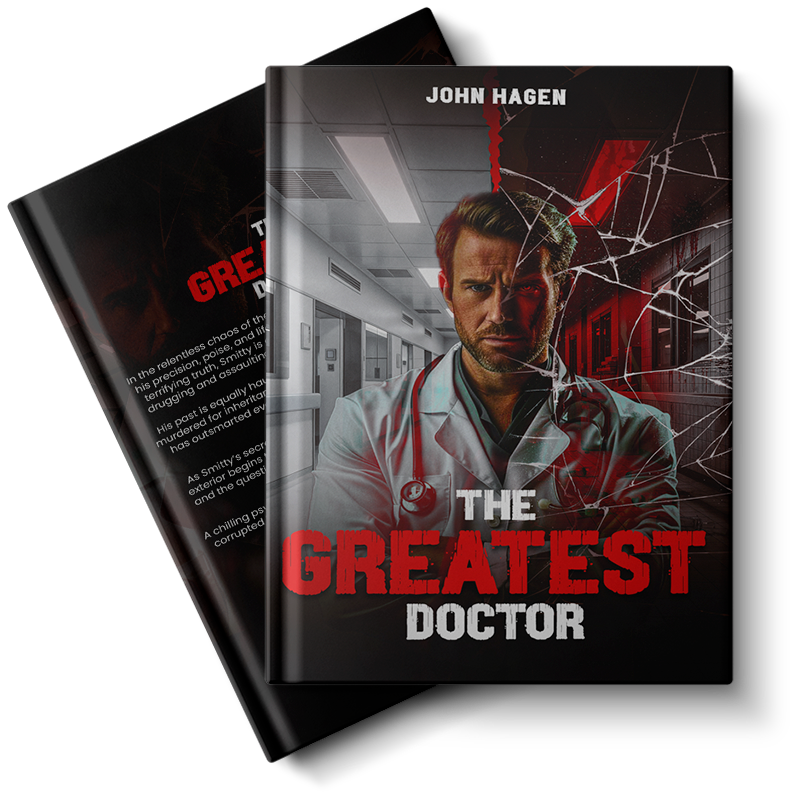
Smitty is a medical marvel. In the high-stakes chaos of the emergency room, his nerve is iron, his skill unmatched, and his confidence absolute. He is the greatest doctor the hospital has ever seen, a world-class single-handed sailor who thrives on split-second decisions and constant superiority. Patients trust him implicitly, showering the administration with letters of gratitude praising the kindness and calm he shows in their darkest moments.
But this facade of dedication and empathy is a perfectly crafted deception. Smitty is a man with a secret, a chilling reality lurking beneath the scrubs and the confident smile. A psychological report identifies him as having a psychopathic personality disorder, marked by a profound lack of empathy, grandiosity, and pathological deceit. The high-pressure world of the ER feeds his ego, but it is his hidden life-seeking anonymous companionship far from the city-that truly relieves the stress. His clandestine rendezvous often involve “easy targets” and a secrecy vital to maintaining his immaculate public image.
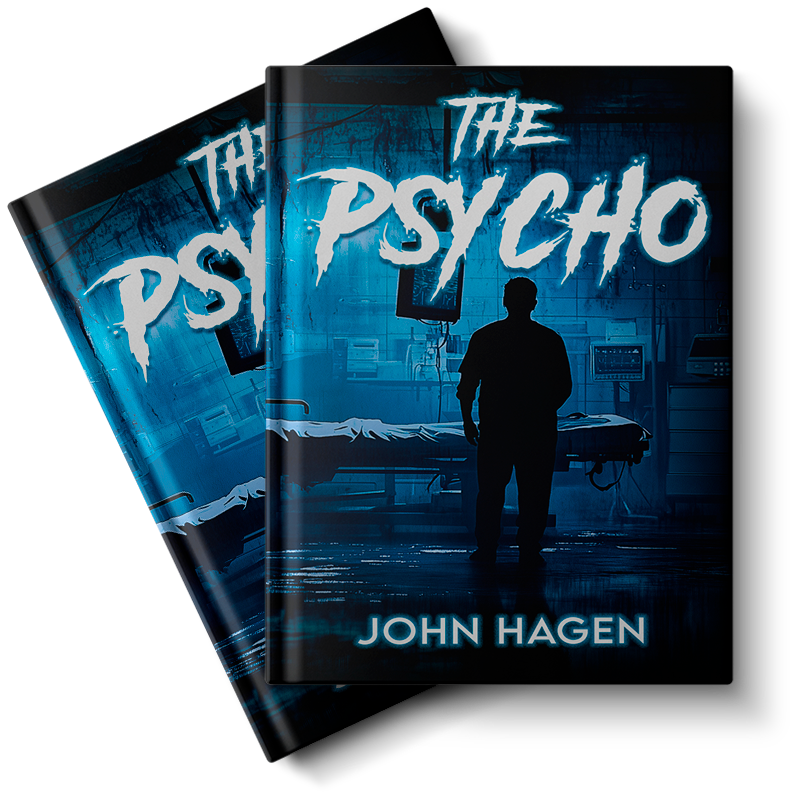
In John Hagen’s gripping medical thriller, The Psycho, the tranquil life of dedicated surgeon Larry Klapman shatters after a routine operation. When Melodie’s father, Jacob Ashinoff, erupts in a terrifying display of rage over a surgical complication, Larry is thrust into a nightmare far beyond the operating room. Jacob, a man of unsettling intensity and formidable influence, pulls Larry into a covert world of international espionage and high-stakes missions.
Larry soon discovers that Jacob’s threats are merely the tip of an iceberg. His daughter’s surgical outcome is intertwined with Jacob’s desperate efforts to prevent an imminent attack on Israel, utilizing advanced Al and cyber warfare. From the treacherous waters of the high seas to the clandestine corridors of an Iranian prison, Larry is forced to confront unimaginable dangers. With his family’s safety on the line, he must navigate a labyrinth of hidden connections and unforeseen consequences. Can this surgeon, whose life was once defined by saving individuals, now help save the world from a hidden global threat? Will Canada become the 51st state? Penned by John Hagen, a seasoned general surgeon, The Psycho delivers a pulse-pounding narrative that blends medical realism with geopolitical suspense, proving that even a flawless operation can lead to the most unexpected and terrifying complications
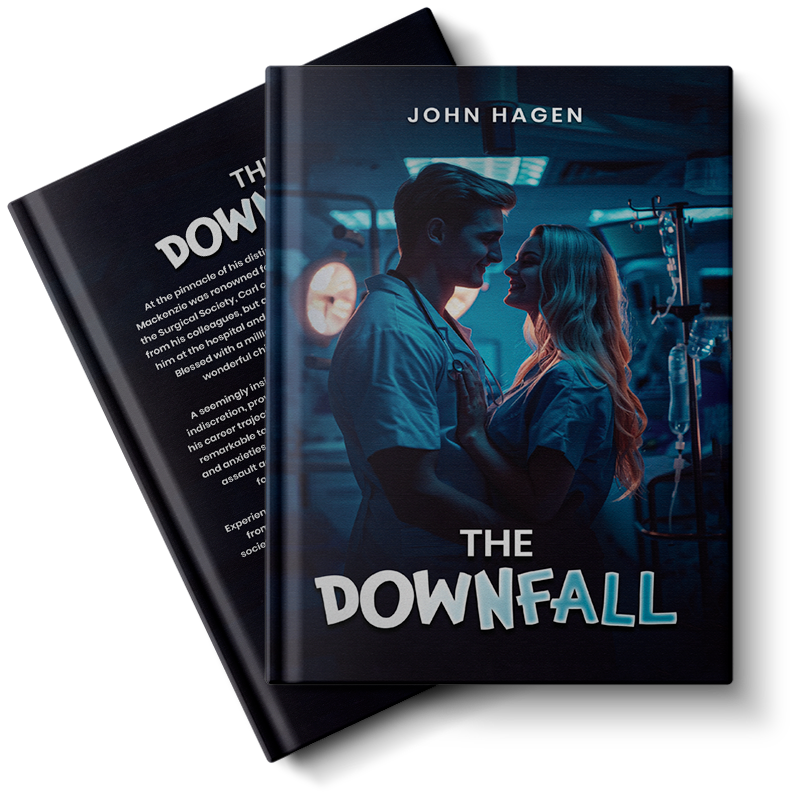
At the pinnacle of his distinguished career in surgery, Dr. Carl Mackenzie was renowned for his expertise and skill. As president of the Surgical Society, Carl commanded widespread respect not only from his colleagues, but also from the nurses who worked alongside him at the hospital and the many patients whose lives he touched. Blessed with a million-dollar family-a stunning wife and two wonderful children-his life was a dream come true.
A seemingly insignificant misstep, which he viewed as a minor indiscretion, proved to be a pivotal moment, irrevocably changing his career trajectory and everything he had worked for. Possessing a remarkable talent for understanding the root of people’s problems and anxieties, the beautiful Sabrina levelled an accusation of sexual assault against Carl. Without a second thought, his colleagues forsook him, leaving him professionally damaged.

A Summiting Mount Everest is a feat few people can imagine. For Dr. John Hegland, a Toronto surgeon, the chance to visit base camp and then speak at a major medical conference in Kathmandu is enough of a thrill. But what started as a quick jaunt turns into a high-stakes adventure. While travelling with Suzie, his partner, John has a random run-in with someone from his past, Eduardo, who plans to climb the world’s highest peak. Despite having fallen out of touch, the two reconnect on their flight to Nepal. Fond memories rush back, but Eduardo, seemingly rudderless, also reveals his complicated past to John. One that continues to haunt him as heir apparent to his Italian family’s fortune. Eduardo is trying to fulfill his dreams and conquer his demons, but John quickly realizes his friend’s life is at stake, and not just from a storm approaching Everest.
Despite all her success as a young Toronto-based lawyer, 28-year-old Lucy Chambers feels like her life is out of control. Especially her weight, which increases to unhealthy levels as she battles the stresses of work, failed relationships, and her ongoing struggles with self-esteem. When all the starvation diets, gimmicks, and gym memberships fail to move the needle in her attaining a healthy weight, Lucy embarks on life-altering bariatric surgery. That’s when her life becomes entwined with unscrupulous surgeons, Mexican drug cartels, and more. Her longtime friend, Suzie, and her partner, Dr. John Hegland, chief of staff at a Toronto hospital, help Lucy navigate the shocking scenarios that later unfold. At the same time, Dr. Hegland tackles daily challenges in dealing with Canadian doctors’ egos in a changing profession where money is short, racism is rampant. The system is broken and Dr. Hegland’s loyalties to it start to waver.

At anchor in the national park


The adventures continue! The stories just keep coming…….