“It’s the best place in the Caribbean,” said Roger.
I figured he would know. Roger has been to the British Virgin Islands 17 times in the past 20 years and has spent the last 3 years sailing the Leeward Islands.
“Little Harbour on Peter’s Island was written up in Sailing magazine,” he explained. “Now that the word is spreading, everyone wants to go there. Most sailors fortunately don’t spend their time reading- too busy drinking- so it is still a secret paradise. You throw your anchor and back up towards the shore. Then tie your stern to the rocks. The water is crystal clear. You’ll see turtles and dolphins. It is the best place to spend a few days.”
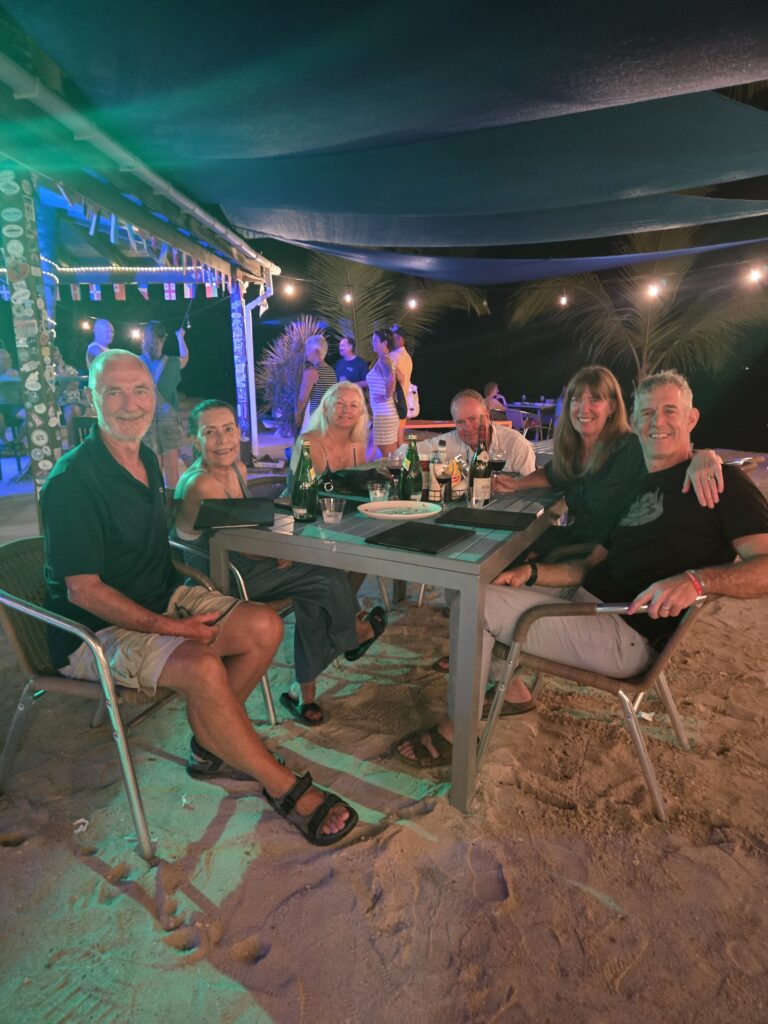
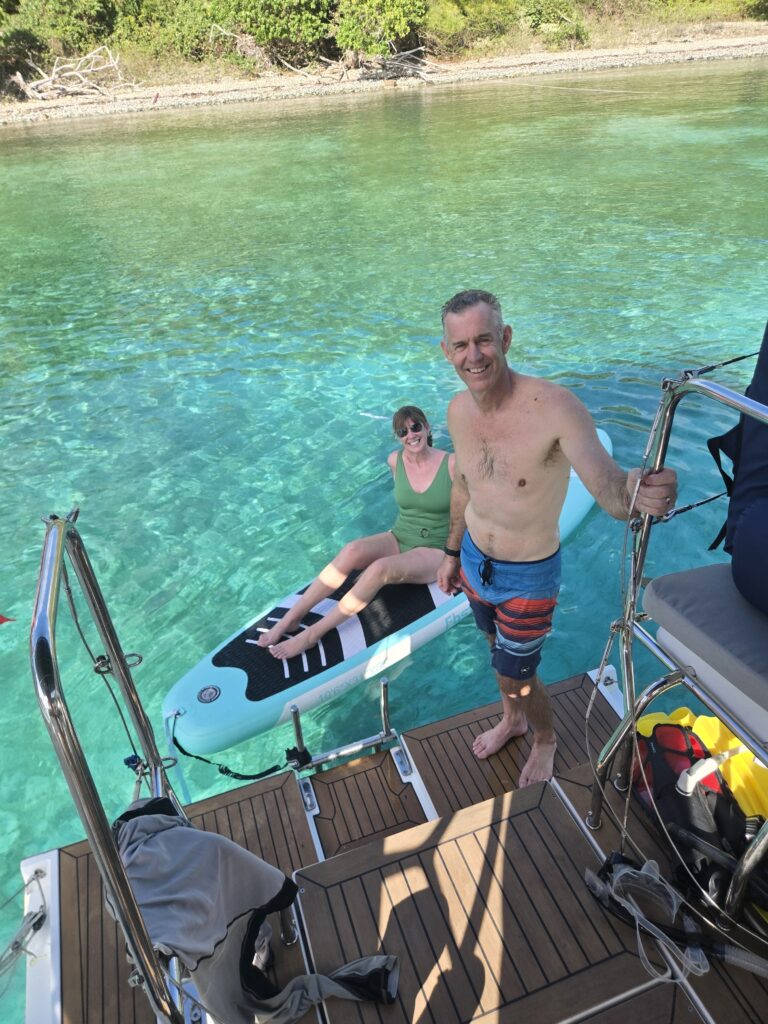
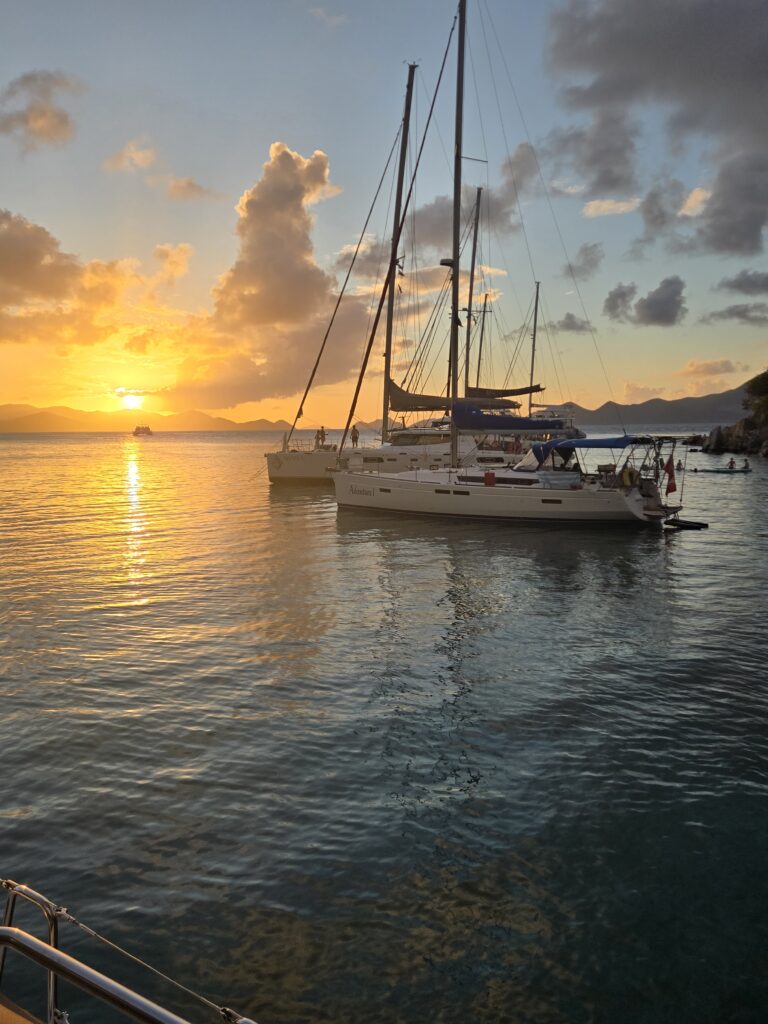
Peter Island paradise snorkeling
From Wikepedia:
In 1968, Torolf Smedvig purchased most of the land on the island for $950,000. He prefabricated 20 luxury A-frame chalets in Norway. In 1969, two ships with thousands of tons of prefabricated buildings, house trailers, concrete, lumber, plumbing supplies, tractors, earthmovers, cranes, and more came over from Norway. Accompanying them was 20 Norwegian craftsmen and works, who worked with about 30 island workers. However, the development was costly and occupancy rates low, leading to significant economic losses. After Torolf’s death, the resort was put up for sale in 1978.
In 1978, the Devos family (Amway Corporation), purchased Peter Island after sailing past it several years before. There, they established the resort that exists today and lived on the island to maintain the resort.
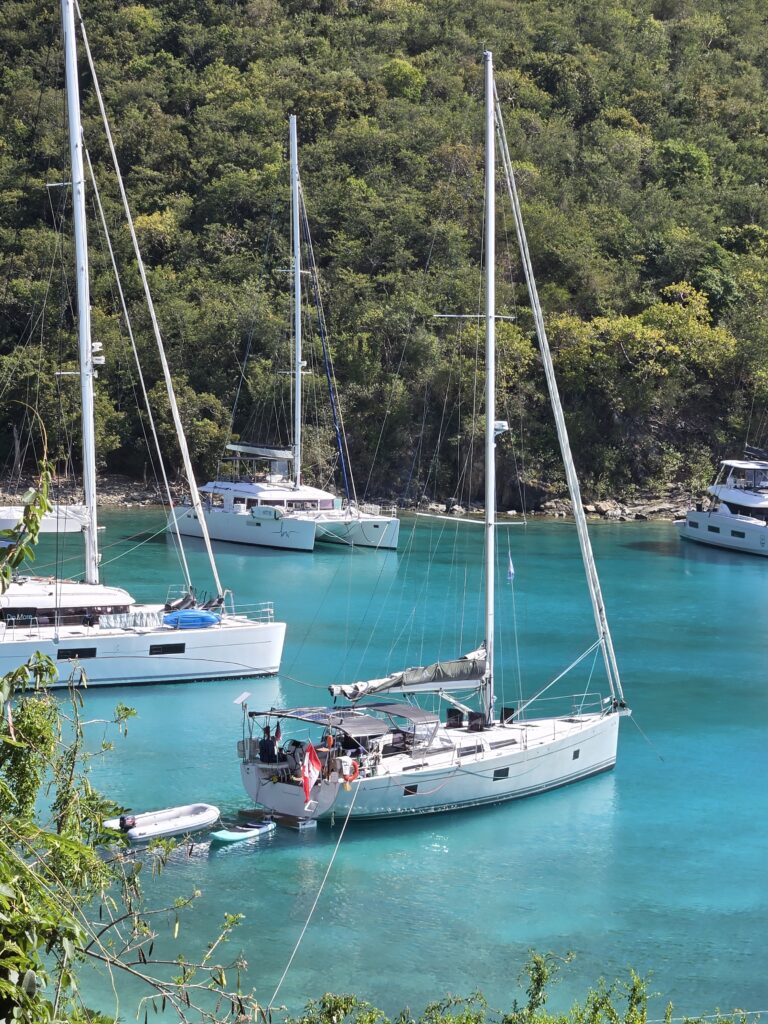
Sailing Vessel Ileana experiencing calm and beauty
The following day, we motored sailed to Trellis bay and picked up a mooring ball. Miraculously, my expert crew were successful not to knock off my bow thruster. (That’s what happened last year….nothing that couldn’t be fixed with a boatload of cash. See previous blogs for this sad story…) This is the best place to pick up guests from the airport. Unsuspecting sailors can be picked up immersing them in the delights of sailing immediately before they have a chance to change their minds.
Laz and Lois arrived in Beef Island after a harrowing flight from Puerto Rico on an eight seater puddle jumper. I greeted them outside the airport with my stained t-shirt and wet swimming shorts in bare feet (I forgot to throw my shoes in the dinghy).
“I’ll take you to the boat,” I said. “It might be a little wet. We can put your luggage in these plastic bags.” A few minutes later, sopping wet we tied up to the sailboat.
“We need to check out from the BVI’s so we can leave at first light,” I explained the following morning. “We’ll sail across the straits to Spanish Town and stay in the marina. The last time I did this, it took four hours. You guys go to the Baths, and I’ll do the paperwork at Customs and Immigration.”
The wind blew in from the east at 26 knots as we approached the dock. We were surrounded by multi-million dollar sailboats as I prepared to show off my boating handling prowess to my nervous crew. I foolishly tried to back in. I was about to smash into a beautifully polished wooden sailboat that gleamed proudly in the bright sun when Bob shouted, “We are going to hit him! Put it in forward gear now!” I could see a hint of panic in his eyes.
Bob was on the bow wearing headphones to make communication with me during these tense and dangerous maneuvers instantaneous and smooth. I poked my head around the bimini and shouted, “What did you say?” The headphones weren’t working well….
The rest of the marina’s docking hands flooded onto the dock when they witnessed what they were dealing with…an unmitigated disaster about to unfold. We made another run at the dock, this time in forward gear. Not sure why, but nothing bad happened.
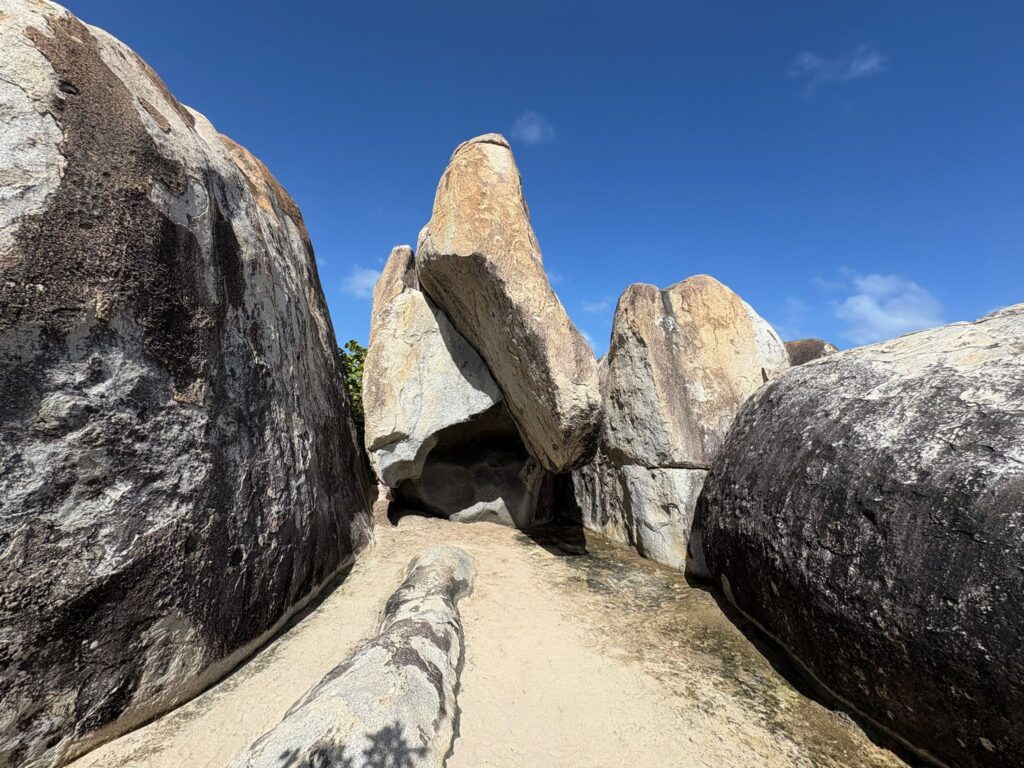
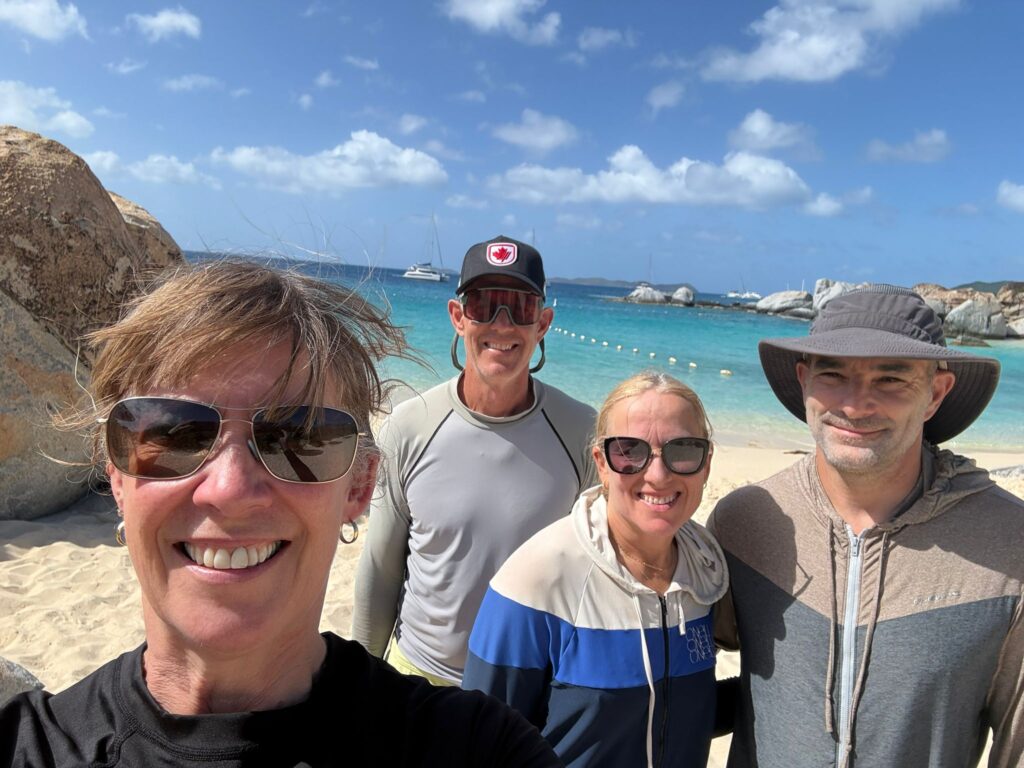
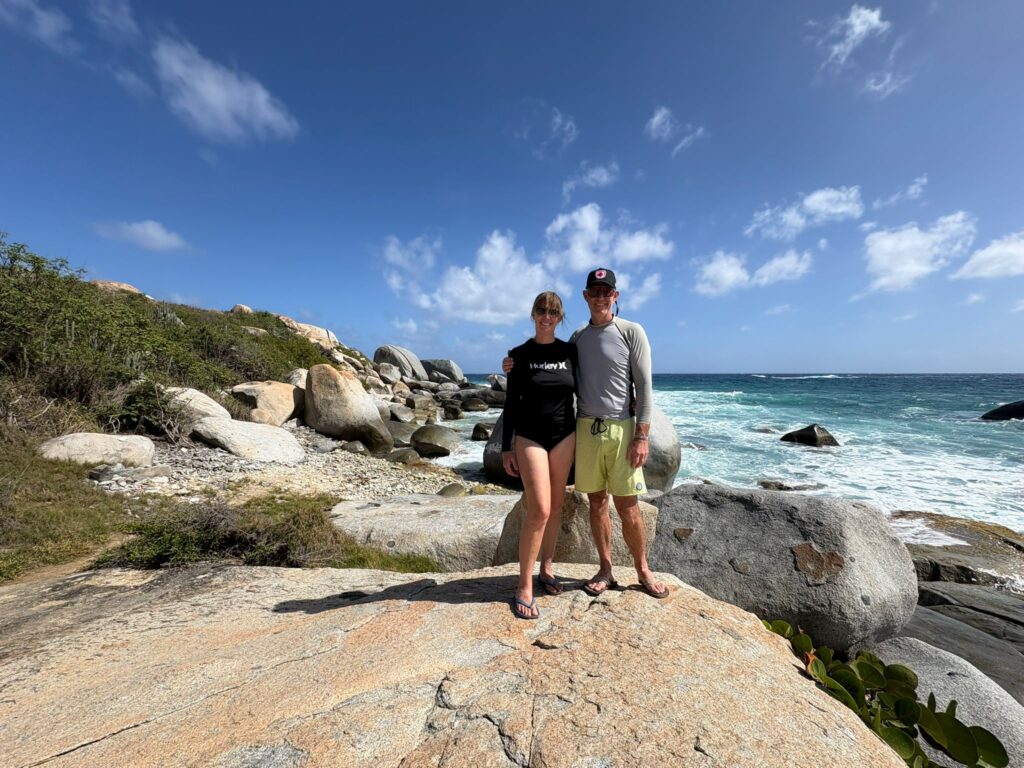
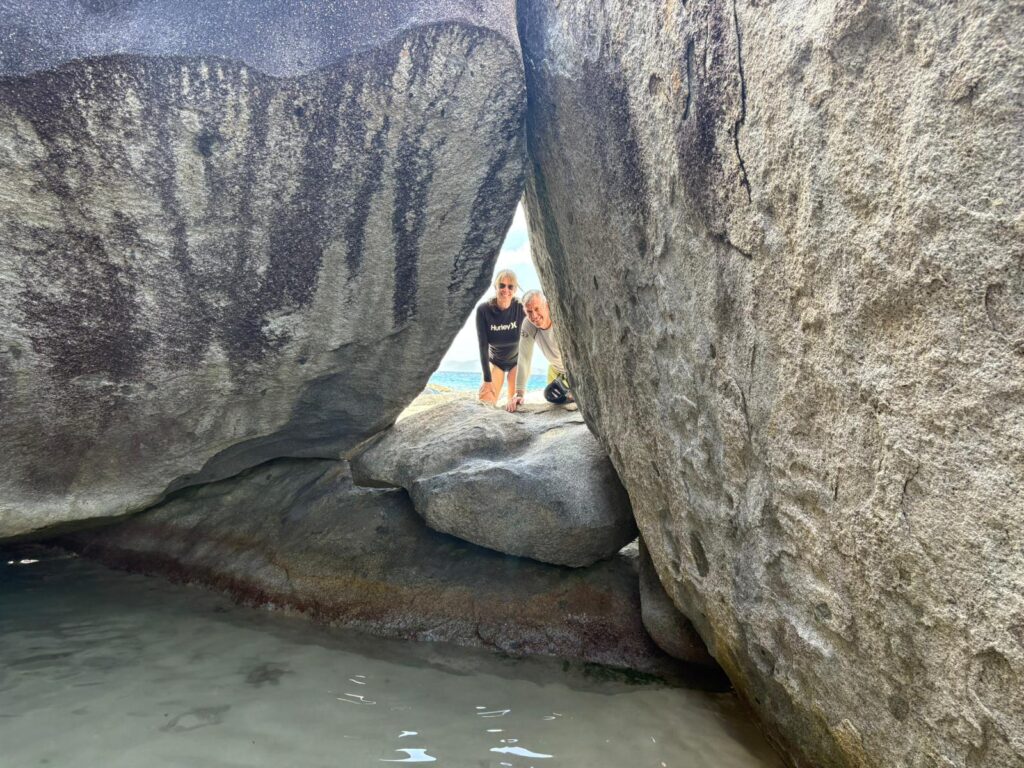
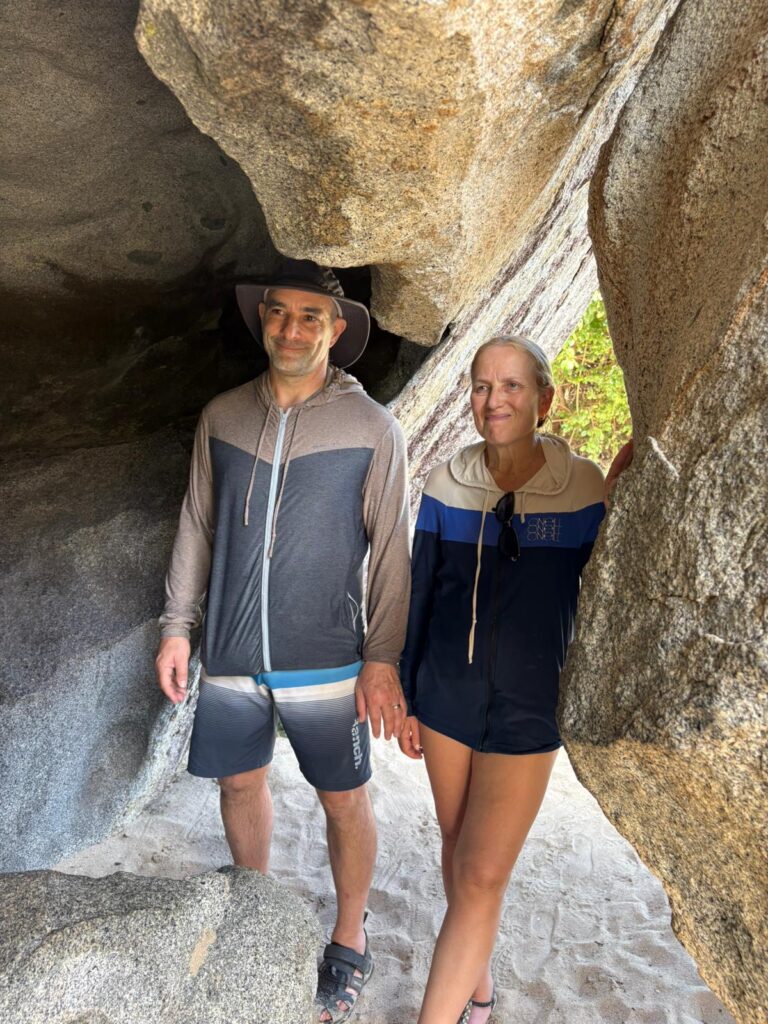
All set to leave at 7 a.m. I decided to wait until a dock hand came to help us of the dock. (That beautiful wooden boat next to us had been cleaned and polished lovingly again the day before by the owner)
“Sure it will be windy,” I said, “but we’ll be going with the wind and waves. The wind should settle in a few days. Culebra is well protected. The marine weather forecast says west bound travel could be ‘too salty for most tastes’.”
“What does that mean,” asked Lois.
“Not sure,” I replied. “They do not say anything worrisome like ‘under no circumstances attempt this passage….’ so I guess we’ll be OK.”
The ‘too salty for most tastes ‘ passage to Culebra in the Spanish Virgin Islands.
Culebra is beautiful, a great anchorage surrounded by reefs to protect us from the waves It was an ideal spot to let our stomachs settle after the nauseating ten foot waves rollercoaster ride. Few sailors stop here, but it is one of my favorite spots.
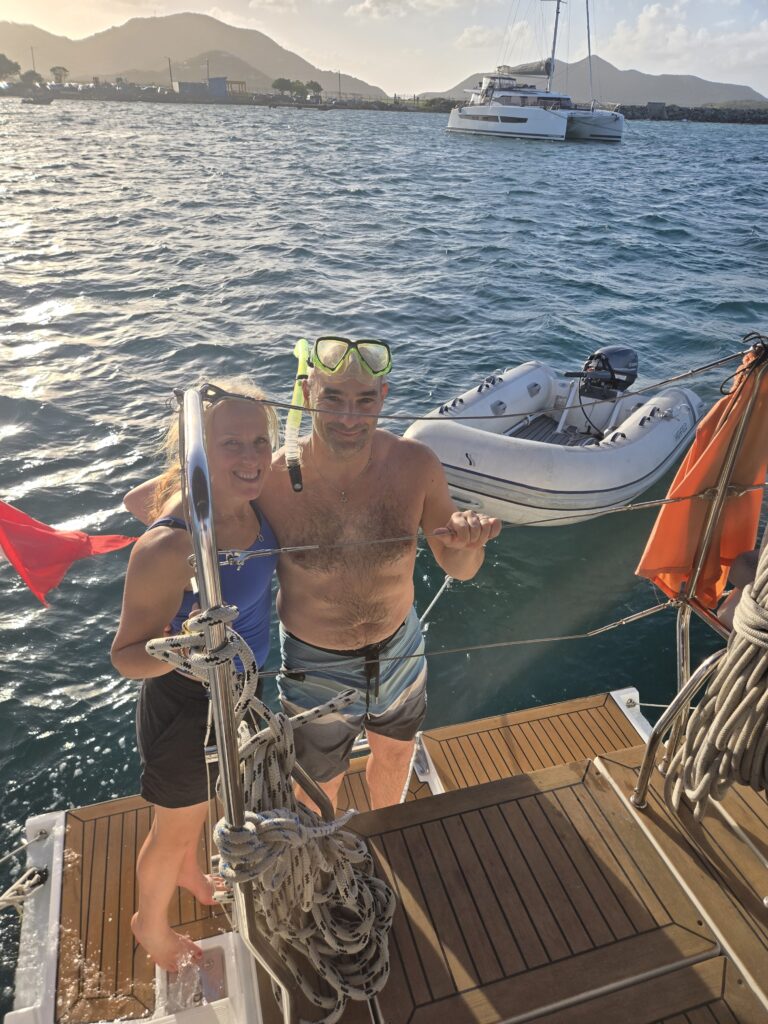
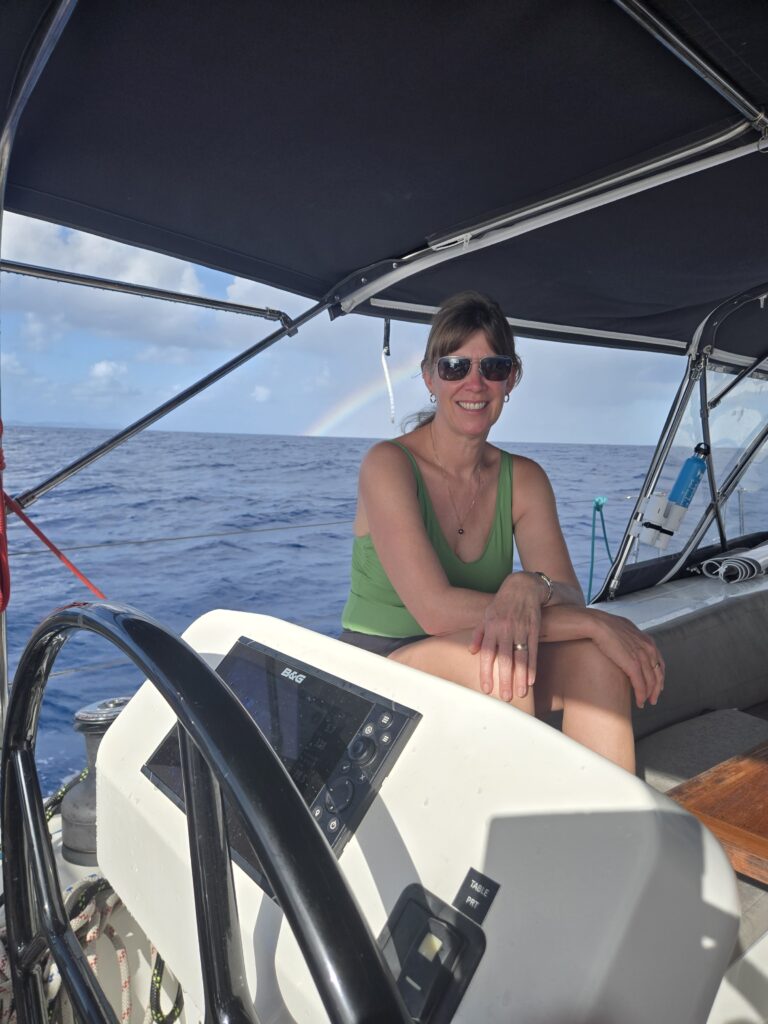
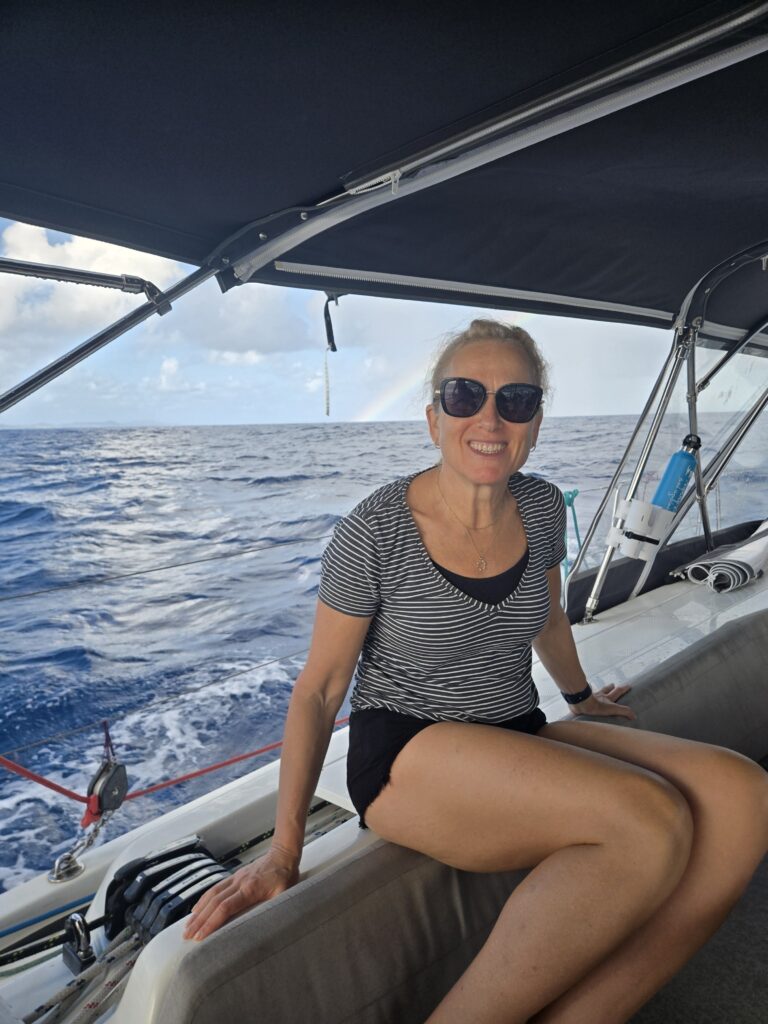
The next stop- San Juan, Puerto Rico. I reviewed the weather forecast and my app which provided me with the latest accurate marine information available. “The wind and waves will be less than yesterday,” I announced with enthusiasm. My crew looked at me skeptically. It was another ‘too salty for most tastes’ sail…
Anchoring in 30 feet of water in the San Juan Bay was a delight. The wind had settled and it was a perfect place to spend a few days to recover after a few days of difficult passages before the overnight sail to the Dominican Republic. The protected harbour is in the middle of the old town of San Juan amongst the old fort and historic sites. The crew went to shore for dinner and supplies. The day was spent exploring followed by amazing dinner prepared by Lois and Jackie. Notable mention of Laz’s high protein pancakes.
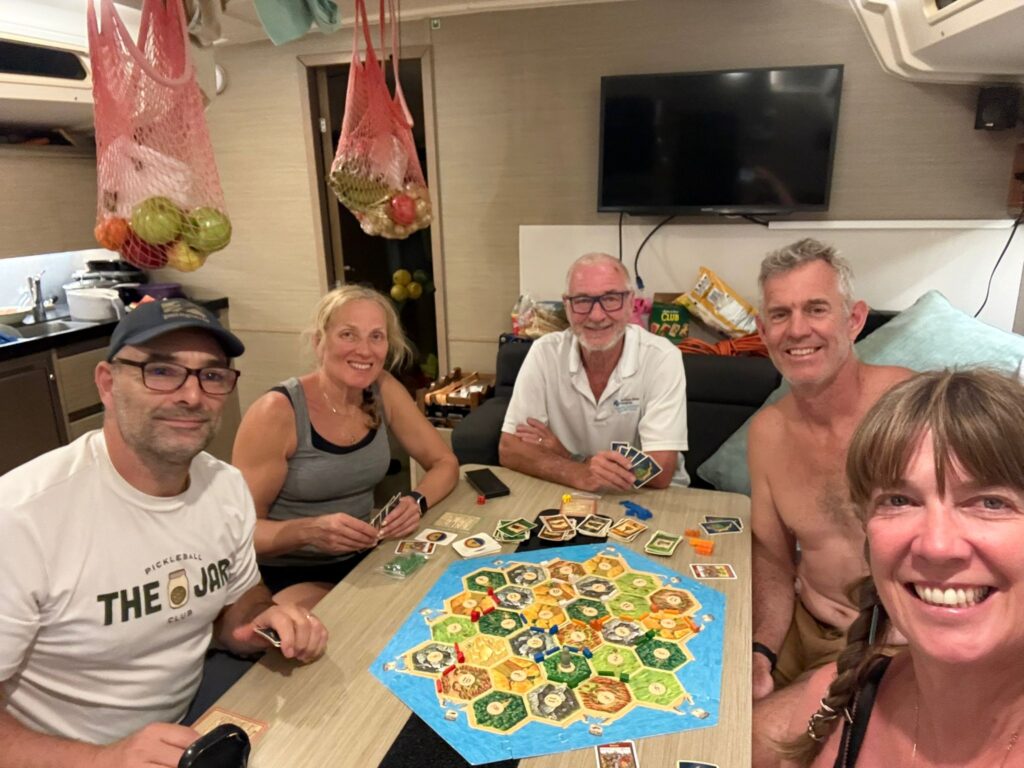
Laz’s famous hi protein pancakes multi-tasking watching hockey
After a good night in calm waters on the San Juan Bay, we were ready for the over night sail. Again, I downloaded the most recent weather and forecast. “It looks like calm waters,” I said. “We’ll likely have to motor sail because the winds will be light.”
“I’ll make dinner and put the individual trays in Tupperware,” said Jackie. I could tell that she was thinking. I could do a better job at predicting weather than your fancy programs.
A google search explains why the crossing is hazardous. “Successful Mona Passage crossings depend on waiting for favorable weather windows, avoiding the hourglass shoals east of the Dominican Republic coast, and timing your departure to minimize exposure to the passage’s strong currents and unpredictable waves. The 80-mile strait between the Dominican Republic and Puerto Rico connects the Atlantic Ocean to the Caribbean Sea, creating hazardous conditions where the two water bodies with conflicting currents and variable tidal flows.”
Leaving the comfort of San Juan in deceptively calm conditions
As my weather app and forecast predicted, the sail was smooth. the winds were light at 12 knots and I launched the massive code 0 sail, a large free flying sail designed for down wind sailing. This is what sailing is all about. Relaxing in comfort while the gentle winds do all the work. Just like the crew had imagined when they signed up for this adventure.
The conditions were perfect….until the easterly swells appeared. They were large-10 feet, but the interval was long and the passage remained pleasant. Some of the crew prepared for the overnight part of the passage by sleeping or reading. (Jackie sped-read one of my books, The Heir, a riviting story of hope and betrayal…). Night was approaching. So was the Mona passage.
“The Mona passage is notorious for it’s unpredictable conditions,” I said.
“Huh,” said Jackie. “I must have missed that memo. What does that mean for us?”
“Well the conditions for passage are favorable,” I replied. The winds are light and the waves are with us. I think we will be fine.”
A sudden gust of 20 knots from the south had us heeled over at an alarming angle. Cell phones and i-pads on the cockpit table flew in a gravity defying motion and rattled on the floor. I rapidly furled the code 0 and launched the much smaller jib. As night was approaching, I said, “It is a wise night sailing dictum to put a reef in the main sail before dark to avoid doing it later.”
As the southerly six foot waves from the Mona passage met the easterly ten-foot waves from the Atlantic the boat was tossed in all directions. Having a third reef in the main made little difference to the pitching and rolling. It was hard to move about the boat without falling down in the jarring motion. We could not tell what was up or down in the pitch blackness. Lois and Jackie scampered into the safety of their cabins.
“It doesn’t seem too bad down here,” I said to Jackie. She gave me an incredulous look as she shook her head. She disappeared into her room to wedge herself with pillows to prevent injury, only to get whacked with the dust buster when it catapulted off the shelf. I got the same response from Lois as she closed the door to her room. The night along with the legendary unpredictability of the Mona passage had arrived. The new moon and dark skies covered in thick black clouds gave little hope of seeing anything in the dark. I was relying on my instruments and instincts to guide me as I climbed behind the wheel and instrument panel.
“The wind has shifted almost ninety degrees,” said Bob as he glanced at the instrument panel.
“That cannot be good,” I replied. “Bob looked up at me as if to say, ‘you mean it could be worse?’
I turned on the radar. “You see the bright red?” Bob nodded. The screen filled with patches of a ruby red colour. “Those are squalls.”
When we got hit with a 33 knot blast a moment later, I furled the jib and headed downwind to reduce the apparent wind speed. We were flying along at 11 knots getting knocked left then right by the massive waves coming from all directions. The squall lasted almost an hour driving us in the wrong direction. When the wind settled and shifted to a southerly, I got back on course. The boat stabilized.
“Who wants dinner?” I asked Bob and Laz. Bob leaned over the stern and vomited.
The dinner was delicious. It was a curried snapper dish on rice. Very spicy, and I had worked up quite the appetite. Maybe not the kind of dish one would want to enjoy twice- going down, then again coming back up. Laz declined the dinner invitation as well…
At some point, Bob went below and crawled into bed. Laz had pulled up the radar screen. “What are the red fluffy patches on the screen?” asked Laz.
“We are in for a few more squalls,” I said. The rain pelted down on Laz, as he was sitting to windward.
“I don’t want to go below,” said Laz preferring to get drenched. “I’m feeling a little nauseated.”
The erratic boat motion finally settled as the boat settled behind the Dominican Republic approaching Samana Bay. We sped along at eight knots as the seas settled. The crew remained settled, now sleeping in the rooms. The malice of the Mona Passage was behind us. By the time the sun rose, the wind was 5 knots. The waves were gone. Lois came into the cockpit with her breakfast of cottage cheese, avocado, and eggs on toast.
“The seas have settled,” she said. “Rough night.”
Arriving in Puerto Bahia Marina in the rain was met with relief from everyone. Although no one kissed the ground, we all felt the urge to do so. The complicated checking in process with immigration and the marina went easily. The marina is part of a four star hotel with restaurants, pools, exercise rooms, tennis and paddle board courts. The sun came out and the crew spent the afternoon at the infinity pool, then the billiard room. My wife, Ileana arrived from Toronto. We went out for dinner at one of the three excellent restaurants at marina.
At dinner, we talked about the great parts of the adventure and the less so great parts. When Jackie’s turn came, she said, “Watching how much you were enjoying yourself in the rough waters, setting the sails, and steering the boat to safety while we hunkered down for me was a highlight.”
I did enjoy myself with my friends. I was never worried about safety. We had tied ourselves onto the jacklines and wore lifejackets during the tempest. Many things in life are like sailing. You navigate through rough waters and arrive at port a better and wiser person than when you had left. It is a lifetime learning journey.
My biggest worry was that I might have poisoned the great adventure with the rough passages. None of the crew regretted coming for the week of sailing. Each one of them felt it was a wonderful experience. We sailed 280 nautical miles across treacherous waters with a harrowing overnight sail. The crew have many stories to tell and many more adventures to experience.
“When you sail for the first time, you have one of two experiences. It becomes a one-time, bucket-list thing you check off your list, or it becomes a part of your soul forever.”—Michelle Segrest